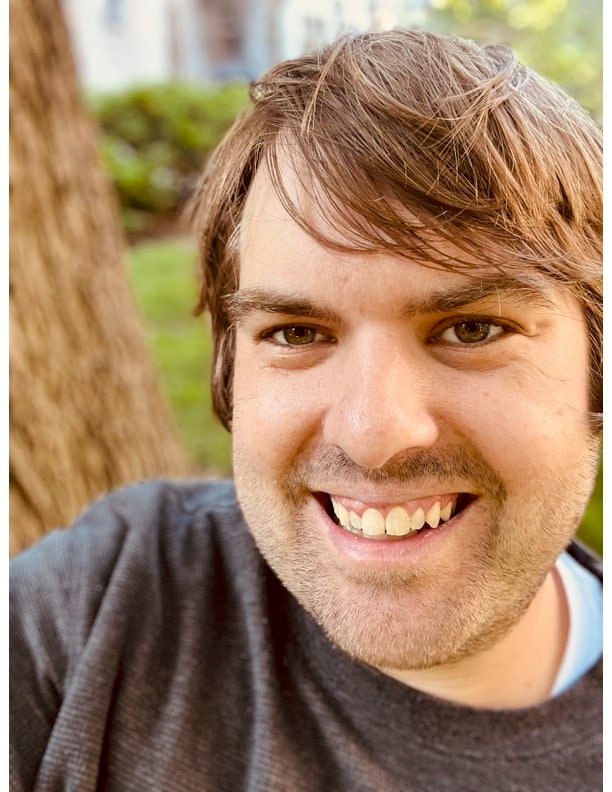
Overview:
Jefferey Webb empowers students to challenge dominant narratives, embrace the complexity of history, and become lifelong learners by connecting rigorous, community-centered teaching with critical inquiry and compassion.
There are teachers who deliver curriculum, and then there are teachers who fundamentally change how students see the world. Jeffrey Webb belongs firmly in the second category.
In a time when education is increasingly pressured to produce higher test scores, faster outcomes, and cleaner narratives, Webb reminds us that the purpose of education is not simply to provide answers, it is to teach students how to ask better questions.
That philosophy is precisely why he has earned recognition as one of our Top 50 Educators.
Webb’s journey into education began long before he earned his teaching certificate. Raised by a mother and aunt who were both educators, he spent countless afternoons and summers in classrooms helping prepare bulletin boards, organize materials, and experience firsthand the rhythm of school life. His love of literature naturally drew him toward teaching English, but it wasn’t Shakespeare or novels that ultimately anchored his career.
It was people.
“The relationships I formed with both my coworkers and students have sustained me over time and kept me coming back year after year,” he reflects.
That understanding—that teaching is fundamentally relational—runs through everything he does.
Today, Webb teaches eighth-grade West Virginia Studies, a subject many might dismiss as regional history. Yet in his classroom, local history becomes a powerful lens for examining justice, identity, labor, and democracy.
One historical moment, in particular, continues to shape his teaching.
While studying the Paint Creek-Cabin Creek Mine Wars, Webb encountered testimony from industrialist Charles Pratt before the United States Senate. When asked why he had not established a school for West Virginia’s miners’ children comparable to Brooklyn’s Pratt Institute, Pratt dismissed the possibility by claiming that the children of miners were “not ready.”
For Webb, that statement is more than a century-old history.
It is unfinished business.
Many of his students live on the very land once occupied by those mining families. Some are likely descendants of the very people Pratt believed were undeserving of educational opportunity.
That knowledge has become his charge.
Every lesson he teaches is, in many ways, a quiet rebuttal to that assumption.
But what distinguishes Webb is not simply what he teaches—it’s how he teaches.
Rather than asking students to memorize historical events, he encourages them to interrogate the stories history chooses to tell. This year, he intentionally centered the concepts of dominant narratives and counter-narratives, helping students recognize that every historical account contains voices that have been elevated and voices that have been overlooked.
Ironically, the tool that helped unlock this deeper thinking was one many educators have dismissed as elementary: the KWL chart.
Using the familiar organizer, students first examined traditional textbook narratives celebrating coal as the engine of West Virginia’s economy. Then Webb challenged them to ask harder questions.
Who mined the coal?
Who profited?
Who paid the price?
As students explored primary sources from the Mine Wars, their understanding shifted. Coal remained economically important, but they also discovered the violence, exploitation, and sacrifice that accompanied its production.
The lesson extended far beyond West Virginia history.
It became a lesson in critical thinking.
It became permission to question.
And perhaps most importantly, it became an invitation for students to reject simplistic explanations—not only about history, but about themselves.
That commitment to nuance extends into some of education’s most difficult conversations.
Teaching in the heart of the opioid epidemic means Webb cannot avoid discussing addiction simply because it is uncomfortable. He understands that nearly every student has been touched by the crisis in some way. Rather than allowing stigma to define the conversation, he invites community leaders, nonprofit directors, and individuals in recovery into his classroom to tell their own stories.
It is an approach rooted not in controversy but in compassion.
Students learn that behind every statistic is a human being.
Behind every policy debate is a family.
Behind every headline is a community trying to heal.
Webb’s influence also extends far beyond his classroom walls.
As a published writer for America Magazine, JSTOR Daily, Learning for Justice, and Literary Hub, he has become one of Appalachia’s most thoughtful educational voices. Through his writing—and through educational resources he has developed for C-SPAN Classroom and PBS LearningMedia—he continues to challenge stereotypes that have long defined the region.
He refuses to allow Appalachia to be reduced to poverty, addiction, or decline.
Instead, he offers complexity.
He offers humanity.
He offers truth.
When asked what policy he would implement if he led the U.S. Department of Education, Webb doesn’t begin with funding formulas or accountability systems.
He offers something much simpler—and perhaps far more radical.
Stop teaching to the test.
Referencing Kelly Gallagher’s Readicide, Webb argues that schools have become so consumed with preparing students for assessments that they are inadvertently destroying students’ love of learning. The irony, he suggests, is that fostering genuine curiosity would likely produce stronger academic outcomes anyway.
His philosophy on failure is equally refreshing.
Somewhere along the way, education began equating passing with learning. Webb rejects that premise entirely.
Failure, he argues, is not evidence that learning has stopped.
Often, it is evidence that learning has finally begun.
Perhaps the most remarkable thing about Jefferey Webb is that after nearly fifteen years in the classroom, he refuses to present himself as an expert with all the answers.
Instead, he still considers himself a learner.
Every year brings new strategies, new perspectives, and new reasons to rethink what he thought he already knew.
In an era that often rewards certainty over curiosity, that humility may be his greatest lesson of all.
Because the best educators don’t simply teach students history.
They teach students how to question it.
They don’t merely prepare students for tests.
They prepare them for citizenship.
And they never stop learning themselves.
Jeffrey Webb exemplifies the kind of educator our profession needs—not because he has mastered teaching, but because he continues to grow alongside the students he serves. That commitment to lifelong learning, intellectual honesty, and elevating voices too often left out of history is exactly why he is one of The Educator’s Room’s Top 50 Educators.

