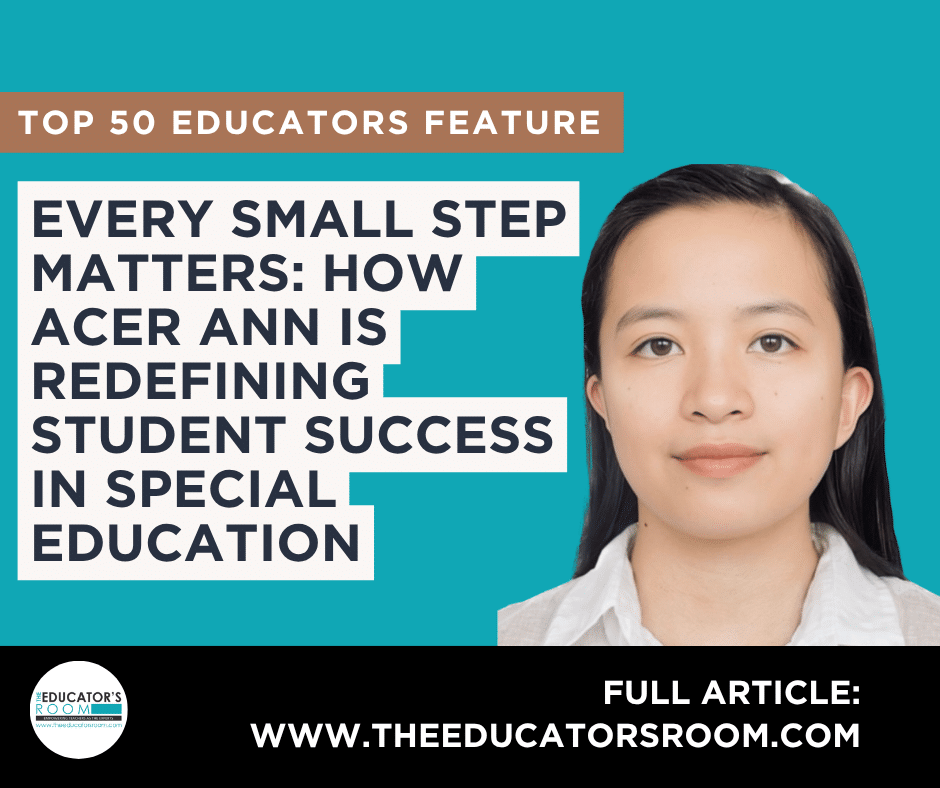
Overview:
Acer Ann believes every student can thrive when educators provide individualized support, advocate for inclusive opportunities, and recognize that meaningful growth is measured by confidence, progress, and potential rather than standardized outcomes.
In a profession often measured by test scores, rankings, and performance metrics, it is easy to overlook the victories that never make headlines. A student reading independently for the first time. A child confidently sharing an idea in front of classmates. A learner writing a complete sentence after months of practice. These milestones may not earn trophies, but they change lives.
For Top 50 Educator Acer Ann, these are the moments that define success.
Teaching was never part of Acer Ann’s original plan. She began her career after earning a degree in special education and teaching in a traditional classroom. It wasn’t until she moved to another country and began working one-on-one with students that everything changed. Those close relationships gave her a deeper understanding of each child’s strengths, challenges, and unique learning needs. More importantly, they revealed the extraordinary impact that individualized instruction can have when educators truly know the students sitting in front of them.
That realization became the foundation of her career.
“At the heart of my work is the belief that every student can learn, grow, and contribute when given the right support and opportunities,” Acer Ann says.
It is a philosophy that extends far beyond the classroom.
Working in special education has taught her that progress rarely arrives in giant leaps. Instead, it comes through countless small victories that many people outside the profession may never fully appreciate. She has watched students learn to decode simple words, solve math problems they once believed impossible, communicate their thoughts with confidence, and discover abilities they never knew they possessed.
To many educators, those moments are everything.
“My students may not always be winning math competitions or science fairs,” she explains, “but I have watched students learn to write clear sentences, read stories independently, and communicate with confidence. Those accomplishments matter deeply because they open doors to greater independence and opportunity.”
That perspective has also fueled her determination to challenge the assumptions society often places on students with disabilities.
Too often, these students are denied leadership opportunities, access to innovative technology, or meaningful roles because adults underestimate what they are capable of achieving. Acer Ann has made it her mission to prove otherwise by designing learning experiences specifically for her students rather than merely adapting lessons created for others.
Among her proudest innovations has been the development of accessible STEM projects that invite students to explore, create, solve problems, and experience success on their own terms.
Her work demonstrates an important truth: inclusion is not simply about placing students in classrooms. It is about creating opportunities where every learner can thrive.
Teaching in a rural community has also exposed another challenge—the inequitable distribution of resources. Rather than accepting those limitations, Acer Ann pursued grants and partnerships to provide instructional materials that otherwise would have remained out of reach.
Seeing once-empty cabinets filled with resources became more than an administrative accomplishment.
It became tangible evidence that advocacy works.
That same spirit of advocacy defines how she approaches education beyond her classroom walls.
She encourages educators to present at conferences, publish articles, join professional organizations, and speak publicly about effective practices. While any single effort may appear small, she believes collective action moves the profession forward.
“Every effort to speak up, share knowledge, and support students helps move our profession forward,” she says.
Her advocacy also extends to teacher wellness.
When asked what advice she would offer educators experiencing burnout, her response begins not with instructional strategies but with self-care.
Teachers, she argues, cannot continue pouring into others if they never replenish themselves. Healthy boundaries, meaningful rest, time with family, and using available support systems are not signs of weakness—they are essential practices that allow educators to continue serving students with excellence.
“Caring for yourself is not a luxury,” she reminds us. “It is necessary if we want to continue caring for our students.”
If given the opportunity to reshape education policy, Acer Ann would begin by asking a question that deserves far more attention: Do standardized assessments truly capture what students know and can do?
For students with disabilities, the answer is often no.
Rather than relying solely on standardized testing, she advocates for assessments that recognize individual growth, celebrate progress, and empower teachers to evaluate learning in ways that reflect each student’s unique journey.
She also believes that supporting students begins with supporting teachers—not simply through appreciation, but through competitive salaries, classroom resources, meaningful professional learning, and leadership that genuinely values teacher expertise.
When educators are equipped to thrive, students do too.
Perhaps Acer Ann’s greatest legacy, however, is not found in grants won, presentations delivered, or policies she hopes to influence.
It is found in something much more personal.
Belief.
She believes that confidence is one of the greatest gifts an educator can give a child. Resources matter. Curriculum matters. Technology matters. But none of those things can replace the life-changing impact of someone who genuinely believes in a student’s potential before the student believes it themselves.
The same is true for teachers.
When educators feel trusted, supported, and encouraged, they become better equipped to create classrooms where every child can flourish.
In an educational landscape often consumed by comparisons and accountability measures, Acer Ann reminds us that student success is not measured solely by standardized scores or awards—it is measured by growth, confidence, and opportunity. Through unwavering advocacy, innovative instruction, and a steadfast belief in every learner’s potential, she is helping redefine what excellence in special education truly looks like.
Sometimes success is not measured by the finish line.
Sometimes, it is measured by the courage to take the next step.
And for the students whose lives Acer Ann changes every day, every small step matters.

