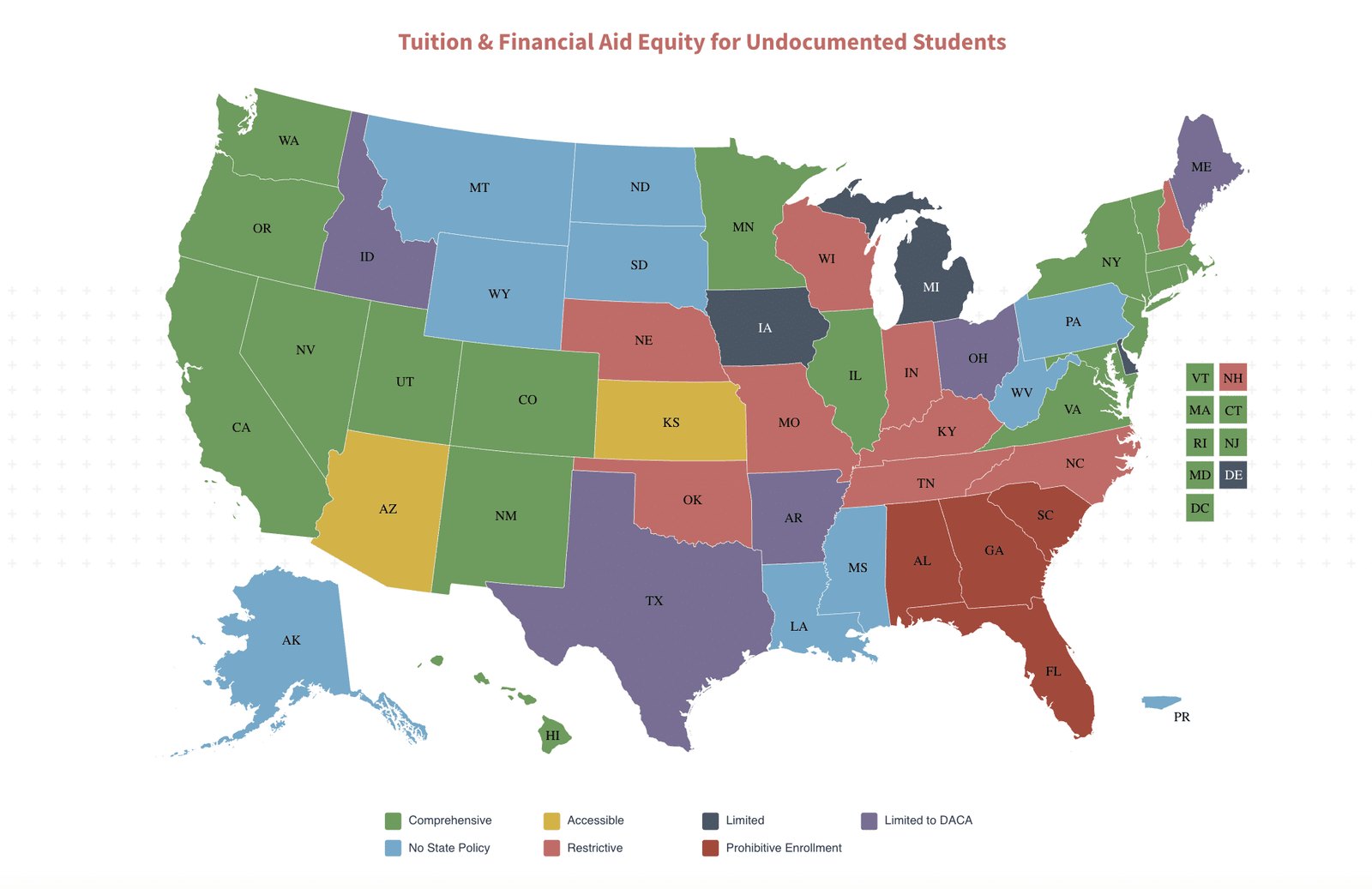
Overview:
The Department of Justice has sued four more states: Arizona, New Mexico, Oregon, and Washington — over laws granting in-state tuition to undocumented students, bringing its total to 21 such lawsuits nationwide, while immigrant-rights advocates signal they’ll push the fight to the Supreme Court amid a broader national picture showing roughly 525,000 undocumented students enrolled in U.S. colleges, most of them concentrated in just five states.
The Department of Justice announced at the end of August that it has filed lawsuits against Arizona, New Mexico, Oregon, and Washington, challenging state laws that grant in-state tuition rates and financial aid to undocumented students. The filings bring the total number of states sued over such policies to 21 since the Department began its campaign against the practice.
In separate complaints filed against each state, the DOJ argues that the laws violate federal statute by extending benefits to undocumented students that are not equally available to U.S. citizens who live out of state. The government is asking courts to block enforcement of the laws, which currently allow colleges and universities in those states to charge in-state tuition to aliens who meet residency requirements, regardless of their immigration status, and to make them eligible for state financial assistance and scholarships.
The Legal Argument
At the center of the government’s case is a 1996 federal law that the DOJ says explicitly bars states from providing higher education benefits to undocumented students based on residency unless they extend the same benefits to all U.S. citizens nationwide, regardless of the state those citizens live in.
“Over 30 years ago, Congress made clear that States cannot put illegal aliens before our Nation’s own citizens,” said Associate Attorney General Stanley E. Woodward, Jr. “By granting illegal aliens in-state tuition, Washington, Oregon, New Mexico, and Arizona are pushing citizens to the side and ignoring federal law. No more. As of today, we have now sued 21 states who we allege were thwarting Congress’s clear prohibition on placing aliens over citizens. Our efforts will not cease until President Trump’s promise is fulfilled: illegal aliens will not receive benefits denied to American citizens.”
Assistant Attorney General Brett A. Shumate, who heads the Department’s Civil Division, framed the issue in similar terms. “This is a simple matter of federal law: colleges cannot provide benefits to illegal aliens that they do not provide to U.S. citizens,” he said. “This Department of Justice will not tolerate American students being treated like second-class citizens in their own country.”
Arizona in the Spotlight
The complaint against Arizona draws on data from a report by the Arizona Center for Investigative Reporting, which projected that more than 3,600 undocumented students per year could become eligible for in-state tuition under the state’s law going forward. According to figures cited in the complaint, at least 720 illegal aliens received in-state tuition across Arizona’s public colleges and universities in the Fall 2025 semester, including 432 at Arizona State University alone.
Citing a roughly $24,000 gap between resident and non-resident tuition rates at ASU, the DOJ’s complaint alleges that illegal aliens received approximately $10.5 million in reduced tuition at that single university in the past year.
Part of a Broader Campaign
Thursday’s filings extend a legal effort that has been underway under Acting Attorney General Todd Blanche. These lawsuits over the past year have yielded mixed results. Texas, Oklahoma and Nebraska ended their in-state tuition policies for undocumented students, while a federal judge struck down the tuition law in Illinois. Minnesota fought (and won) its case earlier this year; however, the Justice Department is appealing the decision. New York and Connecticut have vowed to protect their policies.
Context
The laws being challenged are versions of policies enacted over the past two decades in a number of states, often with bipartisan support at the time, intended to give long-term resident students, including those brought to the U.S. as children, access to the same tuition rates as their classmates. Supporters of the laws have argued they reflect a state’s interest in educating residents who have grown up and attended school within its borders, regardless of immigration status, and that repealing them would price many longtime residents out of higher education. The Justice Department’s lawsuits do not name individual students but seek to enjoin state officials from enforcing the underlying statutes and regulations.
Advocates Eye Supreme Court
Immigrant-rights groups are preparing to push the fight to the nation’s highest court. Thomas A. Saenz, president and general counsel of the Mexican American Legal Defense and Educational Fund, told reporters at a briefing Wednesday that MALDEF and similar advocacy organizations are likely to petition the Supreme Court to take up the issue within the next several months. He said it remains unclear whether advocates would seek review of the lawsuits collectively or focus on a single state.
“The Supreme Court can’t responsibly leave it to each of the different circuits to decide on their own how this gets resolved. So, guarantee this case gets to the Supreme Court,” Saenz said. “When it gets there and what case is really the key consideration. We can’t control all of that.”
With DOJ lawsuits now pending or resolved in 21 states and rulings so far confined to lower courts and one circuit court of appeals, the prospect of conflicting outcomes across jurisdictions has raised the likelihood that the Supreme Court will eventually be asked to settle the question nationally.
The National Picture
Data compiled by the Higher Ed Immigration Portal offers a broader look at who is affected by these tuition fights nationwide. An estimated 525,000 undocumented students are currently enrolled in U.S. colleges and universities, representing 2.4 percent of all postsecondary students. Within that population, roughly 129,900 students, about 24.7 percent, are eligible for DACA protections, a share the Portal says has been shrinking as the program’s fixed eligibility window excludes newer arrivals even as additional students graduate from U.S. high schools each year. Ongoing litigation over DACA and delays in renewal processing have added further uncertainty for current recipients.
The undocumented student population is racially and ethnically diverse: a slight majority, 51.9 percent, identify as Hispanic, while nearly half identify as non-Hispanic, including 21.7 percent who identify as Asian, 13.6 percent as Black, and 8.4 percent as white. The DACA-eligible subset skews considerably more Hispanic, at 75.9 percent, a gap the Portal attributes to the program’s 2007 arrival cutoff, which captures earlier migration cohorts from Latin America while excluding more recent arrivals from Asia, Africa, and elsewhere.
Public institutions enroll nearly three-quarters (74.3 percent) of undocumented students, underscoring the role state university systems play in providing access, while the remaining 25.7 percent attend private colleges and universities, including liberal arts, research, and faith-based institutions.
Five states: California, Texas, Florida, New York, and Illinois, account for nearly 55 percent of all undocumented college students nationally. The Portal notes that the recent wave of DOJ lawsuits, combined with independent state-level moves to roll back tuition equity policies, marks a sharp reversal after roughly two decades in which states gradually expanded access to in-state tuition for undocumented students. It says the shift is already affecting affordability and access for thousands of students, compounding other efforts to limit their access to academic support programs and services.

